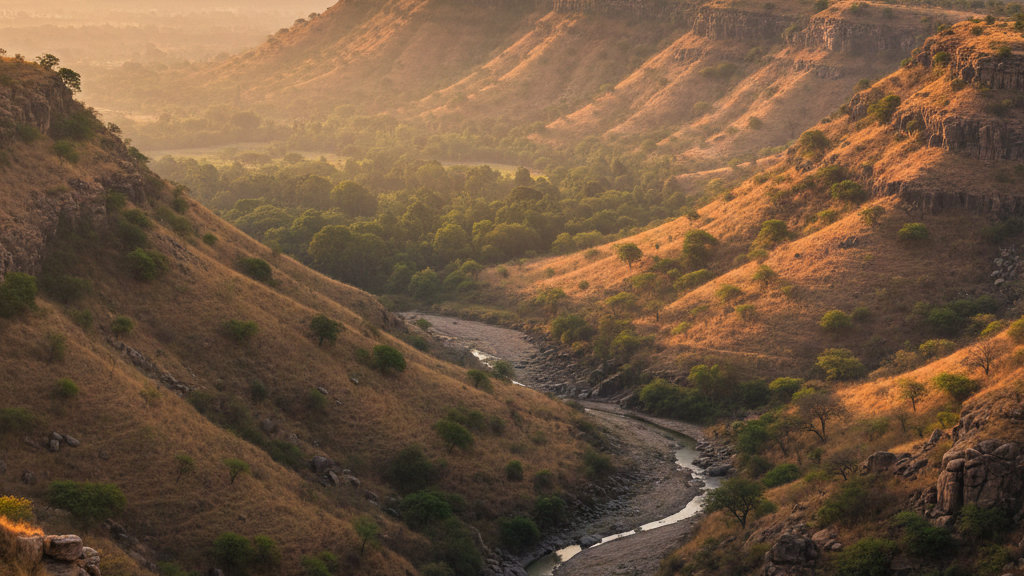
Aravali Ranges: The Great Barrier
The Aravallis are 2 billion years old—older than the Himalayas, older than the dinosaurs. But today, they are fighting for their life in our courtrooms. The November 2025 judgment is not just about a ‘100-metre rule’; it is a verdict on the future of the North Indian climate. Geographically, the Aravallis are our ‘Great Green Wall.’ They are the only thing standing between the fertile heartland of India and the encroaching sands of the Thar Desert.
Environmental Logic & Pros
The Supreme Court, by establishing a uniform definition, has attempted to fix a ‘geographic loophole.’ Previously, different states defined the hills differently, allowing mining mafias to exploit the borders. By halting new leases until a Management Plan for Sustainable Mining is ready, the Court is upholding the Precautionary Principle. It recognises that the Aravallis are a vital watershed for rivers like the Luni and Sabarmati and that their destruction is an irreversible loss to our water security.
The Critique: Height vs. Function
However, as a student of law and environment, I find the 100-metre threshold deeply problematic. Ecology is not a geometry problem. A hill that is 80 metres tall is just as important for groundwater recharge and as a wildlife corridor for leopards and hyenas as a 100-metre peak. By ignoring the low-lying ridges, we are effectively punching holes in our ‘Desert Shield.’ If 90% of the range is now legally ‘not a hill,’ we invite the Thar Desert to advance into Delhi. This is a classic case where administrative certainty has come at the cost of ecological continuity.
The Social & Constitutional Angle
We must also examine Article 21 (Right to Life) and Article 48A (Duty of the State to Protect the Environment). The Aravallis sustain the ‘Green Lungs’ of the NCR. When we mine these hills, we increase the PM10 and PM2.5 levels for millions of people. We also destroy the sacred groves (Orans) and the livelihoods of tribal communities who have co-existed with this landscape for centuries. Is a mining lease worth the collapse of an entire regional water table?
Conclusion: A Call for Holistic Law
To conclude, while the 2025 judgment brings much-needed order to mining regulation, it fails the test of Landscape-Level Protection. We cannot protect a mountain range by protecting only its peaks. My opinion is that the law must move from ‘height-based’ definitions to ‘function-based’ definitions. We must protect the Aravallis not because of how high they stand, but because of what they do: they keep us breathing, they keep us watered, and they keep the desert at bay.
Leave a Reply